

Radiopharmaceuticals are entering a new phase of strategic attention. As large pharmaceutical companies deepen their investment in radioligand therapies and targeted alpha therapies, the field is moving beyond early promise and into a more competitive phase of development. For emerging radiopharma companies, that shift creates opportunity while also raising the bar.
Just last month, BioSpace reported that Regeneron entered the radiopharma space through a Telix collaboration with a total deal value reported at up to $4.3 billion. Truist Securities described Telix as Regeneron’s “entry ticket into the radiopharma game,” noting that the partnership adds another leg to Regeneron’s oncology pipeline.
Scientific differentiation still matters. Strong targets, compelling biology, promising clinical data, and isotope selection remain central to value creation. But as the market matures, potential partners and acquirers are looking beyond the molecule. They are evaluating whether a program can be manufactured, supplied, regulated, transferred, scaled, and delivered. In radiopharma, partner-readiness has become an operational discipline.
Big Pharma Interest Changes the Standard
Large pharmaceutical companies do not evaluate radiopharma programs through a single lens. They look at scientific promise, but they also look at execution risk.
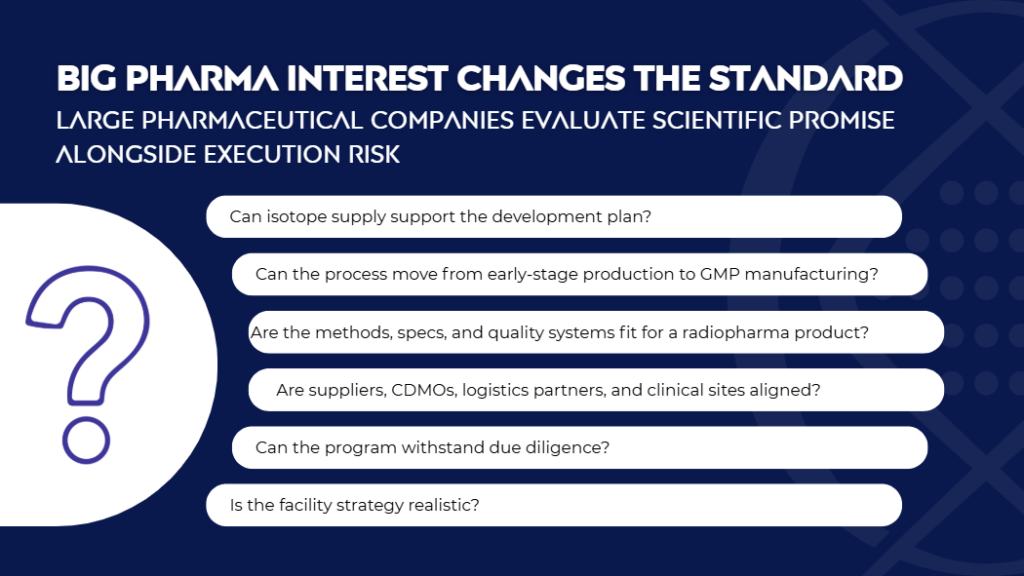
These questions are becoming more important as radiopharma moves from specialized innovation into a broader oncology strategy. The upcoming SNMMI symposium sponsored by Orchestra Life Sciences, “Going Nuclear: Big Pharma’s Radioactive Ambition,” will reflect on this shift directly. The session will explore growing investment by large pharmaceutical companies in radiopharmaceuticals, the rise of targeted alpha therapies and radioligand therapies, and the strategic shifts driving innovation in oncology treatment development.
Regeneron’s John Lin summarized the strategic appeal clearly, describing targeted radiopharmaceuticals as “a rapidly emerging frontier in oncology” and “an exciting opportunity to bring new treatment options to patients.” That opportunity is precisely why emerging radiopharma companies need to be prepared for more rigorous partner evaluation.
For biotechs, this moment requires a more integrated approach. A compelling asset may attract attention, but a credible execution plan is what sustains it.
The Hidden Diligence Questions in Radiopharma
Radiopharma programs carry a unique set of operational dependencies that can create value when they are well managed, or risk when they are discovered too late.
One of the most critical is isotope access. Therapeutic isotopes like Actinium-225, Lutetium-177, and Lead-212 are complex to produce and their supply chains remain highly specialized. Isotope supply constraints are one of the early pitfalls that can put radiopharma programs at risk, especially when developers rely on a single supplier or fail to build redundancy early.
Manufacturing readiness is another critical diligence area. Radiopharmaceuticals cannot be treated like traditional drug products. Many radiotherapeutics begin to degrade almost immediately after production, leaving shelf lives often measured in hours rather than days. That means isotope production, synthesis, quality testing, packaging, release, and delivery must operate with near-perfect coordination.
Facility infrastructure is also crucial as radiopharmaceutical manufacturing requires specialized environments, including hot cells, shielding, robust HVAC systems, radiation safety controls, radioactive waste management processes, and facility designs that account for both GMP and nuclear safety requirements. These critical diligence components are strategic indicators of whether a radiopharma company is truly ready to partner, scale, or commercialize.
Manufacturing Strategy Can’t Wait
In radiopharma, manufacturing strategy cannot evolve quietly in the background as a program advances. It needs to be built into development from the start because the product’s half-life influences the entire operating model, from production timing and QC release to logistics, site scheduling, and patient administration. When each step is connected to the next, even a small delay can affect the full treatment window.
This is why early planning matters. Waiting until later-stage development to address GMP alignment, documentation, analytical methods, supplier qualification, and process scalability can create avoidable risk, especially when early assumptions do not hold up under clinical or commercial expectations. Programs can lose time when GMP standards are treated as a future concern, when processes are designed without scale in mind, or when manufacturing, regulatory, quality, and supply chain teams are not aligned early enough.
As programs advance toward later-stage development and partnership, readiness will depend on CMC discipline, reproducibility, comparability, quality systems, supply planning, and end-to-end operational control. For companies seeking partnership, these details matter because potential partners will want to know whether a program can move forward without major rework. They will evaluate whether the manufacturing process is transferable, whether the control strategy is defensible, and whether the operating model can support the next stage of development.
Execution Is Becoming Part of the Value Proposition
As Big Pharma interest in radiopharma grows, emerging companies have an opportunity to position themselves for partnership, investment, and acquisition, but scientific promise alone will not be enough. Potential partners will want to understand whether a program can be manufactured, supplied, regulated, transferred, scaled, and delivered with confidence.
That requires planning across the areas that determine execution, including facility strategy, GMP startup, vendor coordination, supply chain planning, regulatory readiness, quality systems, and operational execution. At Orchestra Life Sciences, we help radiopharmaceutical and advanced therapy companies align these elements earlier, bringing strategic support and scientific expertise across business strategy, process and analytical development, engineering solutions, capital projects, supply chain, quality and regulatory, and operational excellence.
Biotech leaders must ask whether their programs are prepared for the operational scrutiny that comes with growth, partnership, and scale.
Meet Orchestra Life Sciences at SNMMI
The Orchestra Life Sciences team will be attending the SNMMI 2026 Annual Meeting in Los Angeles, where OLS is sponsoring “Going Nuclear: Big Pharma’s Radioactive Ambition”, a satellite symposium on June 1 from 6:45AM-7:45AM at the LA Convention Center, Concourse Hall 151. Reach out to us at info@orchestralifesciences.com to RSVP today.
The session will feature leaders from Lilly, Novartis, Lantheus, Curium, AstraZeneca, and Orchestra Life Sciences, with discussion focused on investment in radiopharmaceuticals, targeted alpha therapies, radioligand therapies, isotope supply, scalability, competition, capital flow, and the strategic shifts shaping oncology treatment development.
Connect with our team to discuss radiopharmaceutical manufacturing scale-up, GMP readiness, isotope supply strategy, and execution planning.