

Execution as a Design Problem in Advanced Therapies
Advanced therapies are being shaped by constraints that sit outside the lab. Scientific progress continues, but outcomes are increasingly determined by how programs are designed, resourced, and executed as they move toward scale.
Infrastructure Becomes Time-Defining
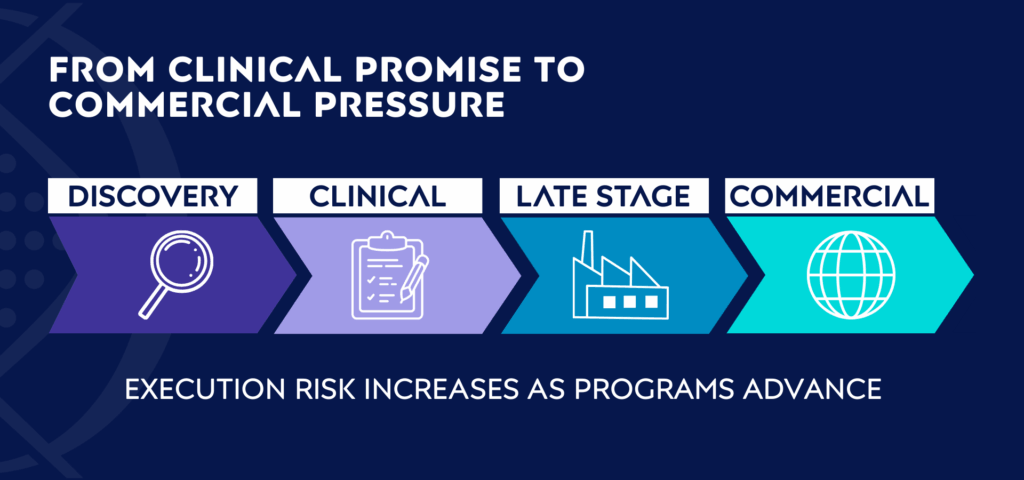
Across radiopharma, cell and gene therapy, and other complex modalities, the industry is transitioning out of a purely R&D-driven era. More programs are reaching late-stage development and more assets are being evaluated for commercial viability. More scrutiny is being placed on whether platforms can scale beyond a single indication or trial.
As more assets advance into later stages, the industry is confronting a different set of pressures. Platforms are no longer assessed solely on clinical promise, but on whether they can be manufactured, regulated, and delivered reliably under real operating conditions. Questions of infrastructure, operating model, and execution readiness now surface earlier, often before teams expect their implications to matter.
This shift has changed where risk accumulates. Decisions once treated as downstream, around facilities, quality systems, and supply chain design, now shape timelines, cost structures, and regulatory trajectories from the outset. Teams that postpone these choices find themselves responding under pressure, while those that address them early preserve flexibility.
At Orchestra Life Sciences, we work with organizations at this point of transition, when execution moves onto the critical path. Our focus is helping teams translate scientific readiness into execution readiness, through deliberate early decisions that hold up as programs advance and constraints tighten.
Capital Follows Execution Readiness
Investors remain active in advanced therapies, but capital is increasingly filtered through execution credibility. Programs are assessed not only on mechanism, but on whether manufacturing, regulatory, and scale assumptions hold up under scrutiny.
This places a different burden on leadership teams where execution can no longer be implied or deferred. Infrastructure plans, timelines, and operating models are examined as evidence that progress is feasible and tangible. Where ambition runs ahead of readiness, the gap becomes visible quickly.
Orchestra helps teams translate strategy into executable plans that withstand investor, partner, and regulator expectations. By aligning technical, regulatory, and operational decisions early, we help reduce downstream disruption and preserve confidence as programs advance.
Complexity Increases Faster than Internal Capability
Advanced therapies introduce operational demands that compound quickly. Short half-lives, individualized manufacturing, evolving regulatory expectations, and non-linear scale place sustained pressure on systems that were not designed for error tolerance. At the same time, internal teams remain lean, timelines compress, and the cost of missteps continues to rise.
When complexity advances faster than internal capability, execution becomes dependent on individual effort rather than institutional systems. That imbalance is difficult to sustain and often surfaces at the most consequential moments, during inspections, tech transfer, or launch preparation. Reliable execution requires repeatable structure, rather than improvised solutions.
Orchestra operates at the intersection of complexity, speed, and risk. We work alongside internal teams to design execution frameworks that hold under pressure, bringing the technical and operational depth needed to scale programs without compromising quality or control.
Patient Impact is Directly Tied to Execution Quality
Patient access in advanced therapies is shaped by execution long before it becomes visible. Delays, rework, and operational misalignment determine whether therapies reach patients at all.
Many of the most consequential decisions are made earlier than teams anticipate, often before pressure exposes their downstream effects. By the time execution feels urgent, flexibility has already narrowed and recovery options are limited.
At Orchestra Life Sciences, execution is treated as an ongoing responsibility, grounded in early, deliberate decisions around infrastructure and delivery that influence how reliably programs translate into patient access. Our work remains focused on supporting that progression as next-generation therapies advance.