
Recent developments in radiopharma suggest that clinical progress, infrastructure planning, and operational readiness are becoming more closely linked.
Radiopharmaceuticals continue to gain attention as a growing area of focus across oncology, precision medicine, and healthcare infrastructure. A recent Forbes Business Councilarticle pointed to scientific innovation, rising demand, and the expanding role of specialized delivery networks as factors contributing to the sector’s momentum.
At the same time, recent developments across the field suggest that radiopharma is entering a more complex stage of growth, with clinical progress continuing, new theranostic approaches advancing, and investment in isotope manufacturing increasing. Because of this, more attention is being placed on the systems required to support these therapies from development through delivery.
Taken together, these signals suggest that radiopharma in 2026 is being shaped not only by innovation at the molecule level, but also by the surrounding infrastructure needed to support clinical readiness and long-term scale.
Clinical Progress Continuing Across New Settings
Recent clinical announcements reflect continued momentum in both alpha-emitting radiopharmaceuticals and theranostic development.
In March, Mayo Clinic announced that it had treated the first patient in the United States in the TRACY-1 trial, which is evaluating actinium-225 DOTATATE in ER-positive, HER2-negative metastatic breast cancer. Mayo noted that this alpha-emitting radiopharmaceutical is being studied in a common breast cancer subtype and that patients must first demonstrate the relevant target on imaging before treatment.
This is notable not only because it represents continued interest in alpha therapy, but also because it reflects radiopharma’s movement into broader clinical settings that depend on precise patient selection and coordinated site readiness.
In early April, Huntsman Cancer Institute announced that the first three patients in the world had been treated in a first-in-human clinical trial of RYZ401, an investigational Ac-225 theranostic for neuroendocrine tumors and other solid tumors. Huntsman also noted that radiopharmaceutical trials require specialized infrastructure and close collaboration among imaging scientists, physicists, physicians, and clinical trial teams.
These examples reinforce the broader point that radiopharmaceutical development is continuing to expand, but advancement depends on more than promising therapeutic concepts. It also depends on whether the clinical environment is equipped to support safe, coordinated, and repeatable execution.
Infrastructure and Access Remain Important Considerations
Alongside clinical momentum, recent industry activity also points to continued investment in isotope supply and manufacturing capacity.
Last month, TerraPower Isotopes announced a $450 million investment in a new cGMP actinium-225 manufacturing facility in Philadelphia, alongside expansion of its Washington operations. Reported plans indicate that the effort is intended to significantly expand production capacity, with production expected to begin in 2029.
This type of investment is significant because actinium-225 continues to attract interest as a therapeutic isotope, while supply remains more limited and manufacturing pathways remain more complex than those of more established radiopharmaceutical isotopes.
More broadly, recent activity across the sector suggests that manufacturing geography, isotope access, and network design are becoming increasingly important considerations alongside pipeline progress. Recent commentary highlighted in UroToday reached a similar conclusion from a clinical perspective, noting that theranostic approaches are expanding, that imaging remains central to patient selection and treatment planning, and that healthcare systems will need to be prepared to support broader access to radiopharmaceutical therapy in both research and care settings.
Viewed together, these developments suggest that access in radiopharma is increasingly tied to more practical questions, such as where isotope supply will come from, how production capacity will be expanded, which sites are ready to manage these therapies, and how networks will support reliable delivery.
What the Industry Solution Increasingly Requires
As radiopharma advances, the solution is not a single technology or a single investment. It is alignment across several key areas that must work together.
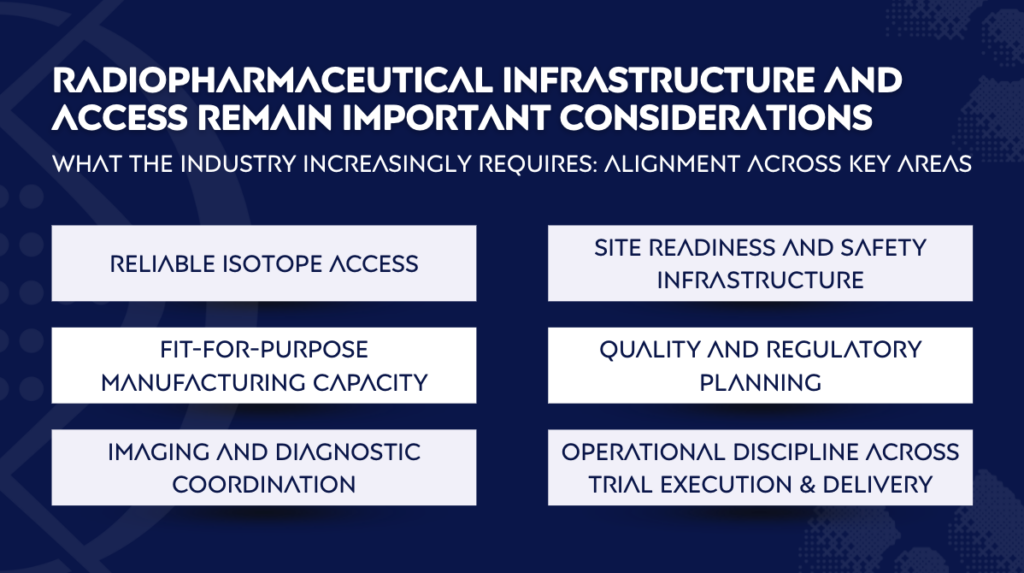
The operational complexity of radiopharmaceutical trials includes timing constraints, licensing requirements, radiation safety programs, documentation demands, and the need for careful coordination across manufacturing, transport, imaging, and site operations. Even relatively small delays can affect imaging windows, patient scheduling, and data integrity.
That operational reality is especially relevant as alpha-emitting therapies and theranostic programs continue to move forward. In this environment, readiness depends not only on the therapeutic concept itself, but also on whether the surrounding systems are prepared to support it.
How Orchestra Life Sciences Helps
At Orchestra Life Sciences, we help clients align the infrastructure and execution elements that shape radiopharmaceutical readiness, including isotope strategy, facility planning, manufacturing strategy, supply chain planning, and operational execution. Our role is to help clients align these elements early, reduce avoidable delays, and prepare programs for the realities of clinical and commercial development.
Connect With Us at Upcoming Conferences
This spring, Orchestra Life Sciences will be attending several key industry events, including the Canadian Radiotheranostics Leaders’ Summit (May 25 – 26 in Toronto) and the SNMMI Annual Meeting (May 30 – June 2 in Los Angeles).
Reach out to schedule time with our team and continue the conversation.